We train for these
Direct
The bomb, the bullet, the burn — the known stressors that will arise. Expected, and rehearsed against constantly.
Impact on performanceLow
The thesis
In our work, we've seen it over and over: performance doesn't break in the moment — the moment only exposes it. The breakdown was built earlier, in the accumulation nobody was tracking.
So we don't wait for the moment. Our architecture is scientifically designed to agitate the nervous system — to induce the behaviors that mirror real-world conditions, and surface what's building before it costs someone the outcome.
The differentiator
The obvious threat isn't what drives performance breakdown. In our operational work, the direct stressor everyone trains for moved the needle the least. The damage came from the load stacking around the threat — the indirect and the peripheral.
The bomb, the bullet, the burn — the known stressors that will arise. Expected, and rehearsed against constantly.
The pressure around the threat. Often unexpected in the moment — but the kind of thing you can see coming.
The small, ambient things you have zero control over — and that have zero bearing on the mission. Yet they breed dissonance, confusion, agitation, and frustration. That's exactly what makes them so powerful.
What we watch
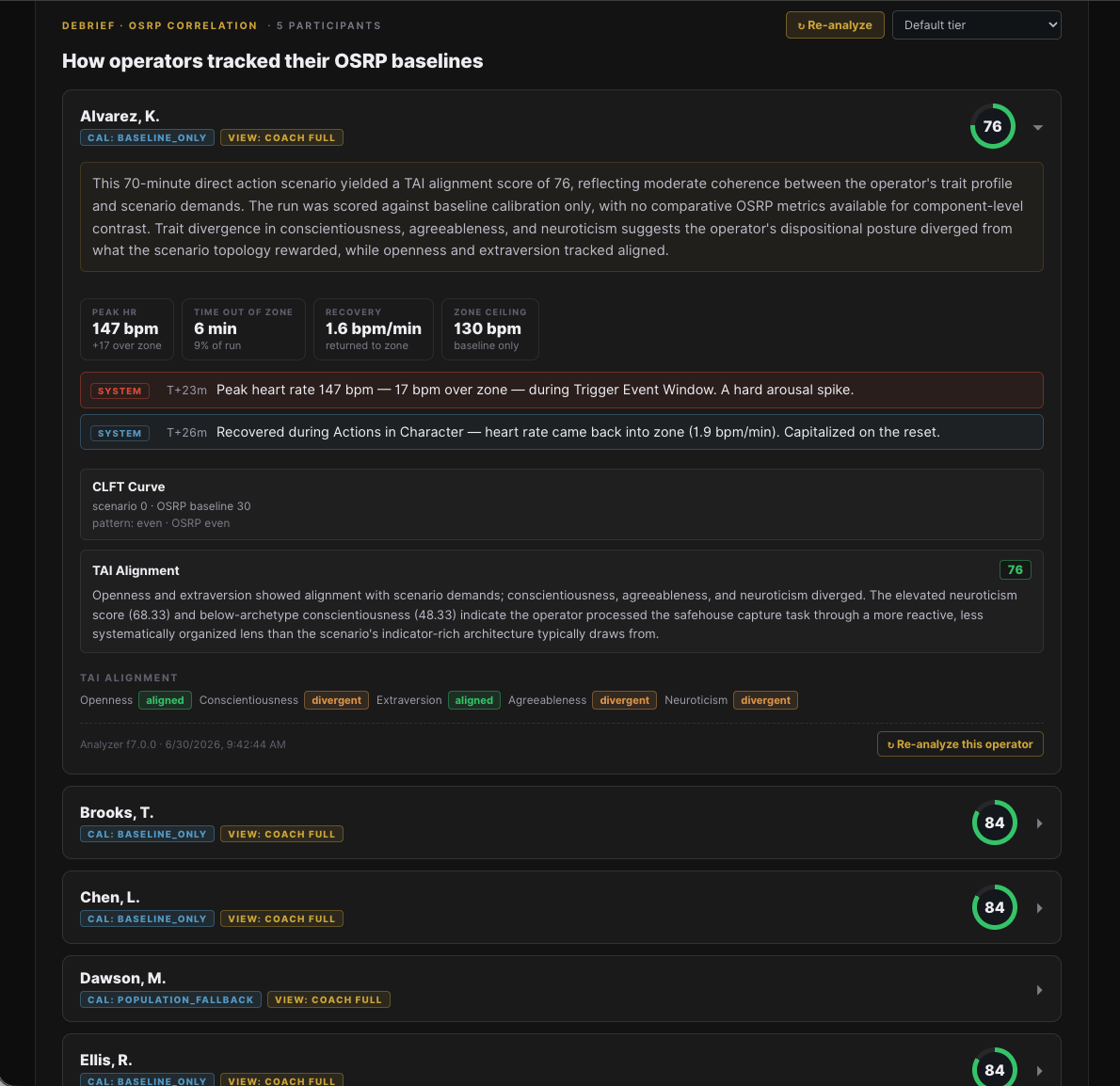
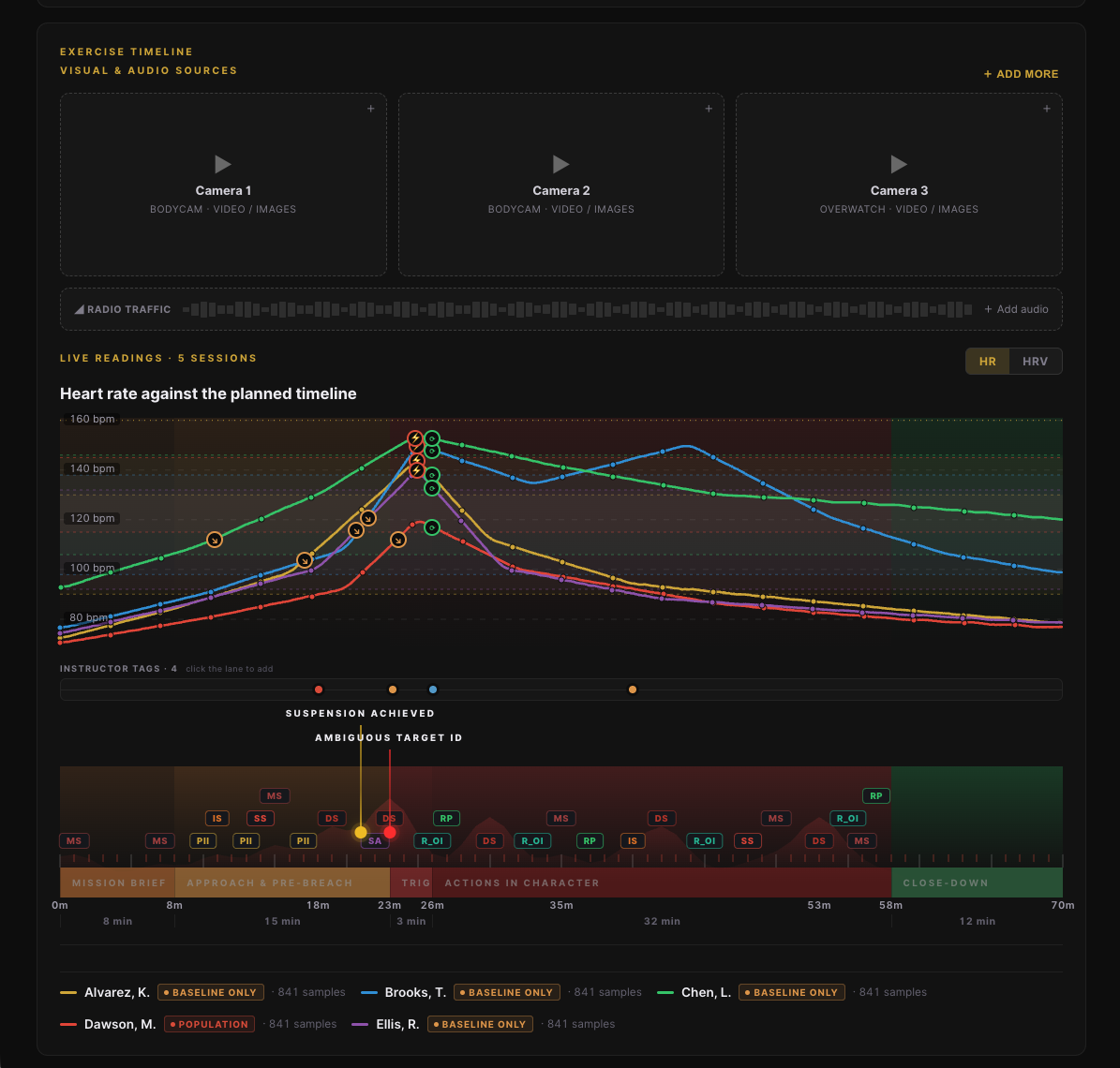
Every person under load traces an arc. The model is HRV-native — HRV drops, stays low, then rises — and HR is its mirror: it rises, holds high, then drops. Three things define the arc, the same whether you're running a raid, a burn, or a red-zone rep.
Measured continuously, time-aligned to what actually happened, and read against that person's own baseline — never a population.
What we deliver
We don't hand you a chart and walk away. We deliver methods to change the arc:
Everyone's arc is unique, so we build individual profiles — measured against clear results and outcomes, not against strangers. A defensible read of this person, and a specific path to a better arc next time.
The Architecture
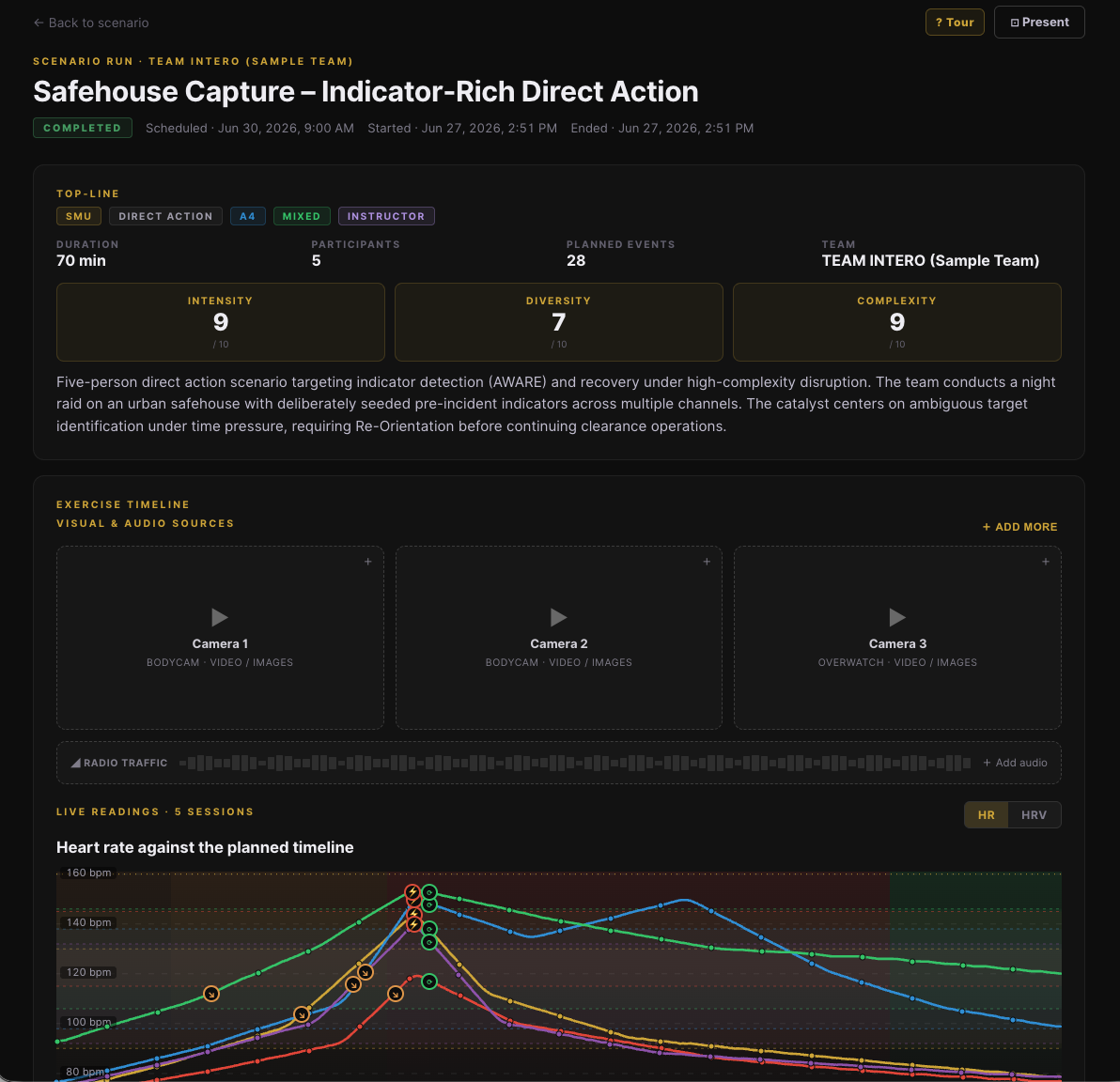
Twenty years of field methodology — the Human Performance Learning Protocol — structured into stages you design against. Every scenario you build lives on it; every run you review is plotted against it. Direct, indirect, and satellite stressors are placed on purpose, across the stages.
Establish the operating environment. Stage the minor signals — the scenario's ambient noise floor.
Open the storyboard, capture buy-in, set tempo. Realism, relevance, and value land here.
Plausible Suspension of Disbelief opens. Pre-Incident Indicators prime perception.
Trigger event fires. Participants operate through stress clusters. Recovery engineered in.
Down-regulate. Review METL/KSA data. Integrate the disruption so adaptation holds after the scenario ends.
Instructors
The instructor sees the human. The data sees the system. Neither is complete alone — LiveLabs puts them in the same place, live.
the data flags a state change and points you to look.
what you observed and what the body did confirm each other. When they don't agree, that gap is its own signal.
where your read and the physiology meet — that's the truth you can actually coach on.
Instructor Mode makes it usable in the moment: a live board of green / yellow / red, one-tap tags on a person or the whole group, and a buzz on any state downgrade — so your eyes stay on your people, not a screen.
Trust
We read only the sessions someone opts into. Anything daily or overnight stays the individual's alone.
Staff get the group and coach views; an individual's data is never surfaced to peers.
Personnel-liability exposure in tactical. The CBA in pro sport. The firewall was designed around those realities, not despite them.
A chest strap for the session, a band for readiness. We never touch consumer health-app data.
Built for
Unit-level exercise design, AAR-quality capture, repeatable scenarios across rotations.
Mission-rehearsal drills with real physiological feedback. Train the recovery in.
Scenario-based training with measurable readiness, before and after exposure.
Team-wide readiness across training, competition, and recovery.
Leadership cohorts, integration and crisis teams, the same protocol.
Human-performance labs and longitudinal studies with real rigor.
The vocabulary changes — operators to athletes, scenarios to practices. The rigor doesn't.
Proof
“As a twenty-year veteran of the Green Berets, I was absolutely awestruck by the enhanced performance realized through Jeff's programs — revolutionary methods of bio-feedback in real-world scenarios he personally developed.
“Jeff's experience and credibility in the field made an immediate and lasting impact — he redefined leadership for our group and shifted the way they saw being a teammate, a leader, and an individual.
From the founder
The methodology was hand-derived in operational environments where regulation wasn't a wellness conversation — it was the thing that determined whether you brought everyone home. Intero is the platform version of that work. Personal, coach-supported, team-deployable. Same methodology, productized — finally portable to everyone who needs it.
Thirty years of serving with and training individuals across the Fire Service, Law Enforcement, Special Operations & SMUs, Intelligence Operatives, Professional Athletes and Pro Sports teams, Fortune 500 CEOs and even Competitive Chefs — one thing has been clear: failure wasn't driven by a lack of skills, it was driven by a broken system that couldn't find clarity in the moments that mattered most.
Jeff Banman
Founder · INTERO Performance, LLC
Schedule a demo
We're opening early access to a small number of teams while we dial in deployment. Setup includes a two-day certification — your people leave able to run this themselves. We're transferring a capability, not selling a subscription you can't operate.